
D. Joy Riley, M.D., M.A.
Executive Director
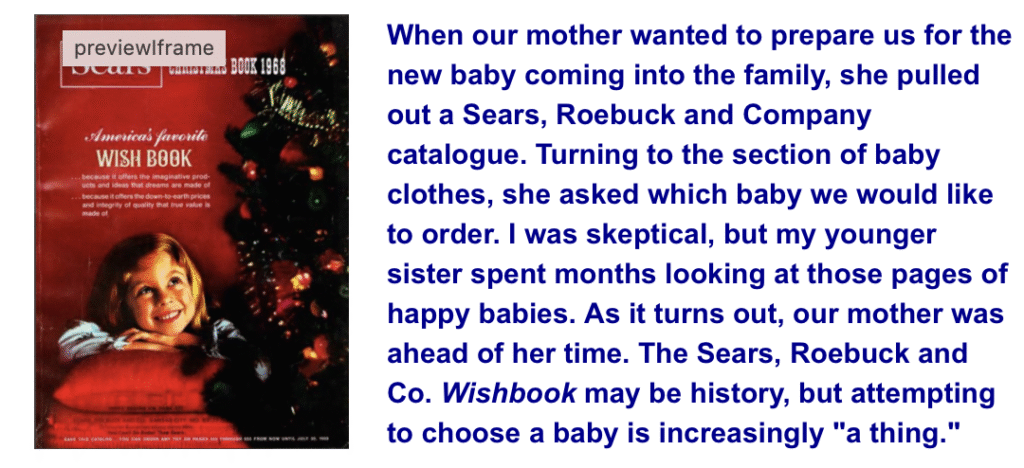
Pick Your Baby
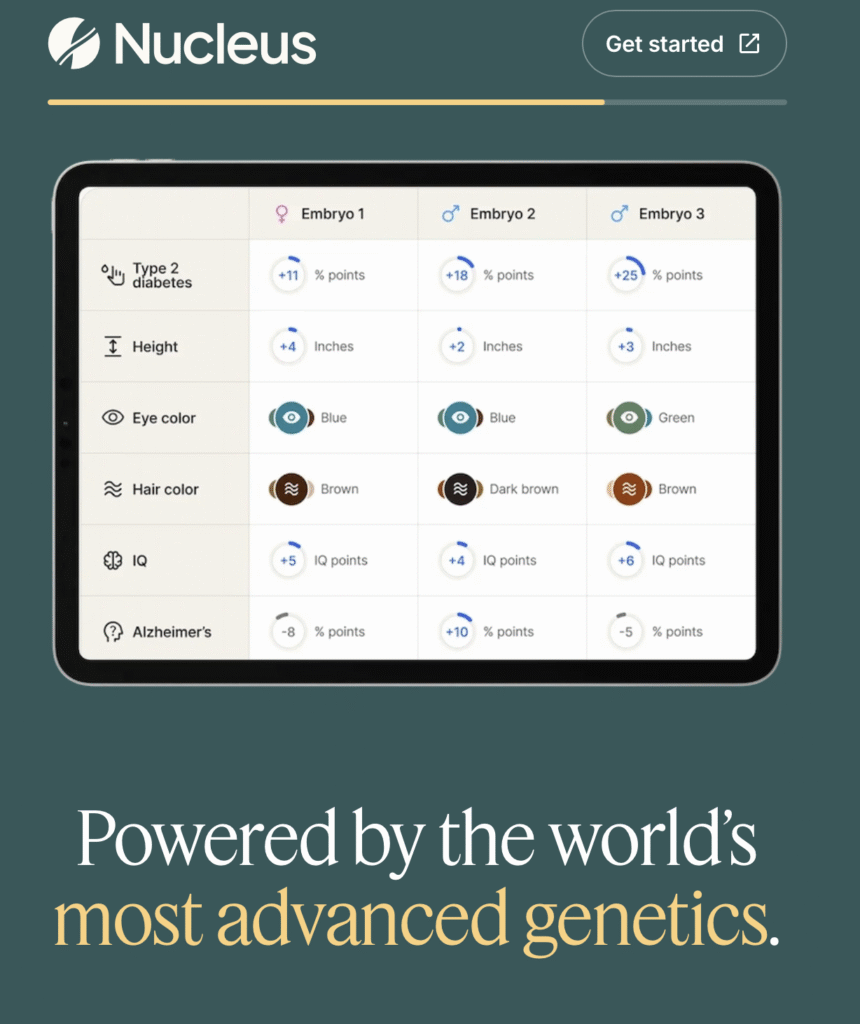
No longer a fantasy game, picking your baby is now on offer — at least, if you believe the advertisements. The Nucleus website touts decreased worry, risk, and uncertainty for potential parents. How? It begins with the would-be mother and father submitting their cheek swabs for genetic testing of 2,000+ conditions. The current cost of the “mash-up” of the two genomes is about $1,000. That precedes undergoing what the website calls “IVF+,” the cost of which is not detailed.
Physician, scientist, ethicist, and former consulting neonatologist John Wyatt discusses PickYourBaby.com here. Dr. Wyatt underscores the fact that such advertising preys upon would-be parents’ fear and anxieties. He rightly sees the process as eugenics being “rehabilitated” and sold as responsible behavior. Moreover, the proposal plays havoc with our understanding of what it means to procreate. When we choose our children based on preferential characteristics, they cease to be gifts, and become projects instead. What happens when said chosen child does not live up to parental expectations? Or (gasp) develops some unexpected health/medical condition? Wyatt has multiple concerns about this enterprise and its cultural milieu, and he is not alone.
The Tennessee CBC has written about the gift of children before (Can We Deal with the Truth?; Subsidizing Desire; and Déjà vu all over again to name a few). Joyce Shelton, Ph.D., authored the apposite Editing Our Future. C. Ben Mitchell, Ph.D. reviewed Oliver O’Donovan’s important book on this subject thusly:
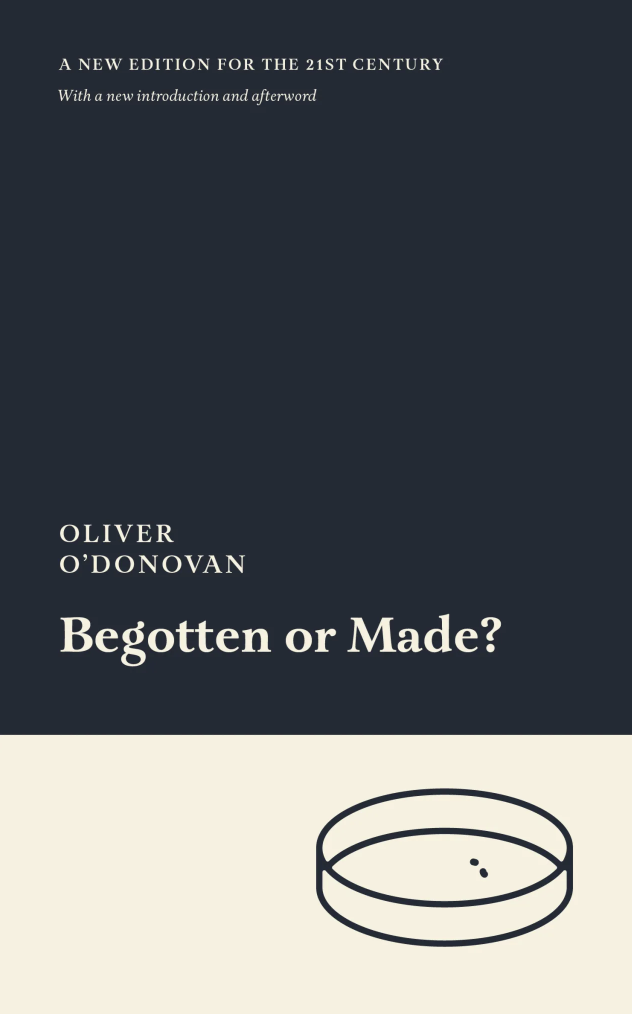
Begotten or Made? A New Edition for the 21st Century by Oliver O’Donovan
This volume is a much-needed reprint of an extraordinarily insightful essay by one of this century’s best thinkers, Oliver O’Donovan, former Regius Professor of Moral and Pastoral Theology at Christ Church College in Oxford. It includes an afterward by the author and a very helpful introduction by Matthew Lee Anderson of Baylor University. The book comprises a series of prescient public lectures given by O’Donovan in 1983, just over the threshold of the new reproductive technologies, especially in vitro fertilization. O’Donovan makes the case that medicalizing what he calls “sex by artifice” (making as opposed to begetting) has caused us to lose sight of the meaning of the human person.
Meanwhile, in the UK, the government, through the National Health Service (NHS), is collecting newborn genomes.
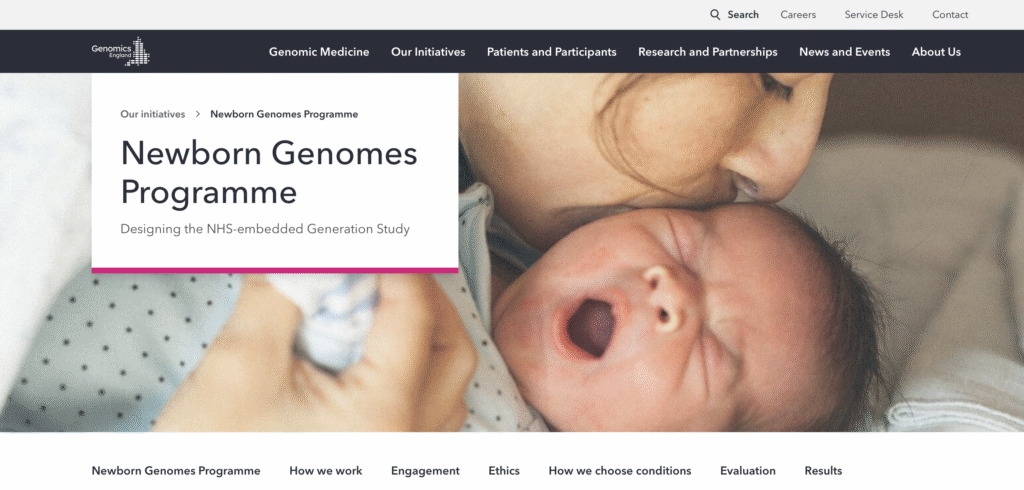
Thumbnail descriptions of a few of the ethical issues involved in the Generation Study can be found here. What about the very important issue of consent? The parents provide consent for their newborn to be tested. The young person will also be asked for his/her consent — at about the age of 16 years. The options at that point would be to continue to be a part of the study or to withdraw. We should not neglect to understand that the adolescent will have been a human research subject for 16 years without his/her consent.
The “Generation Study” will evaluate genes for more than 200 rare conditions (list begins here) that “usually appear in the first few years of life.” The goal is 100,000 genomes using cord blood. The data is stored and can be accessed for research into genetic disorders or for developing new treatments.
What happens when false negative or false positive results are delivered to the parents? The Generation Study website states, “It is also important that we take steps to minimise incorrect results and monitor this throughout the study.” Further explanation is not given, but assuredly will be needed.
According to The Guardian, there is hope that the Generation Study will help repair the NHS:
Wes Streeting, the health secretary, said the future of healthcare must be “more predictive, more preventative and more personalised” to help fix the “broken” NHS. “This kind of advance in genomics will help us achieve just that,” he added.
Where Do We Go from Here?
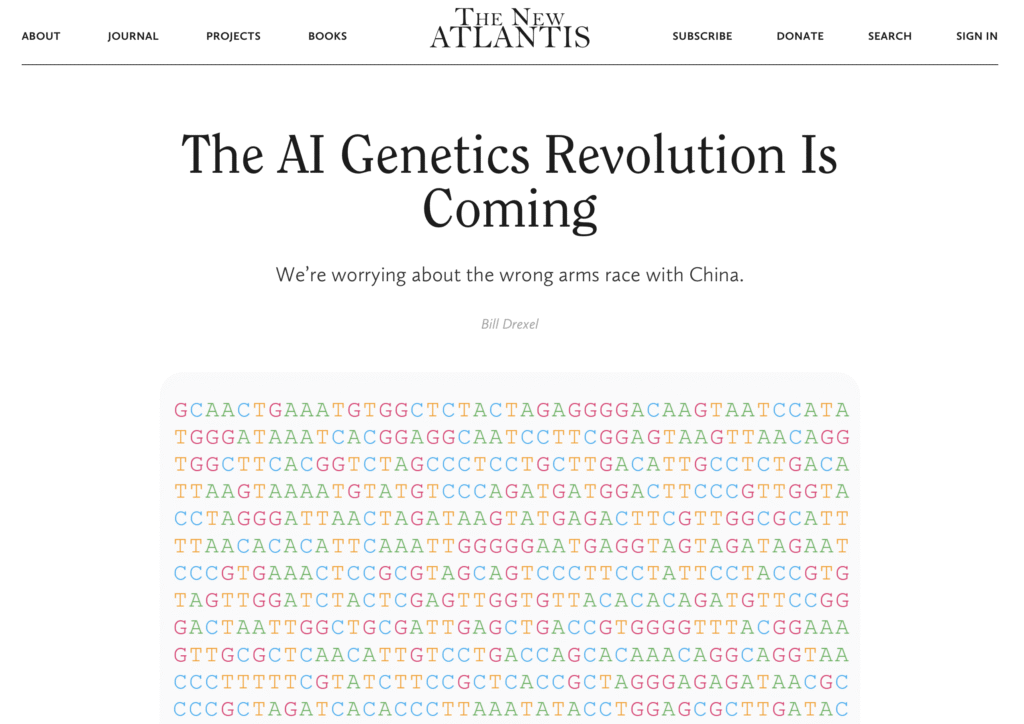
A sobering read is linked below: “The AI Genetics Revolution Is Coming.” The article’s author, Bill Drexel, explains:
At the time of writing, the most wide-ranging and ambitious project using AI to decipher the language of genetics is the Evo 2 system released by the Arc Institute, Nvidia, and others in February. As a report by Stanford University notes, the system is trained on the genetic information of “all known living species — and a few extinct ones,” comprising a dataset of almost 9 trillion nucleotides, in and a few extinct ones,” comprising a dataset of almost 9 trillion nucleotides, in hopes of parsing the function of DNA in every domain of life. It has already shown promise in predicting which among an individual’s many genetic mutations are most likely to contribute to diseases like cancer, in identifying new relationships between multiple scattered genes, and in writing novel genetic code.
Drexel has a number of concerns, such as:
Eugenics — the use of in vitro gametogenesis (IVG) to produce eggs and sperm from other human body cells, then use AI to screen “industrial quantities” of embryos made from these . . .
China’s goals of dominance: “to edge out the United States in AI by 2030 and in biotech by 2035.”
China’s plan to “improve the quality of the birth population.” Drexel notes that BGI is China’s “leading genomic company.” The president and cofounder of BGI forbids his employees from having children with birth defects, which he says would be a “disgrace” to the company. Not one of the 1,400 children born to employees has had serious congenital diseases, he says.