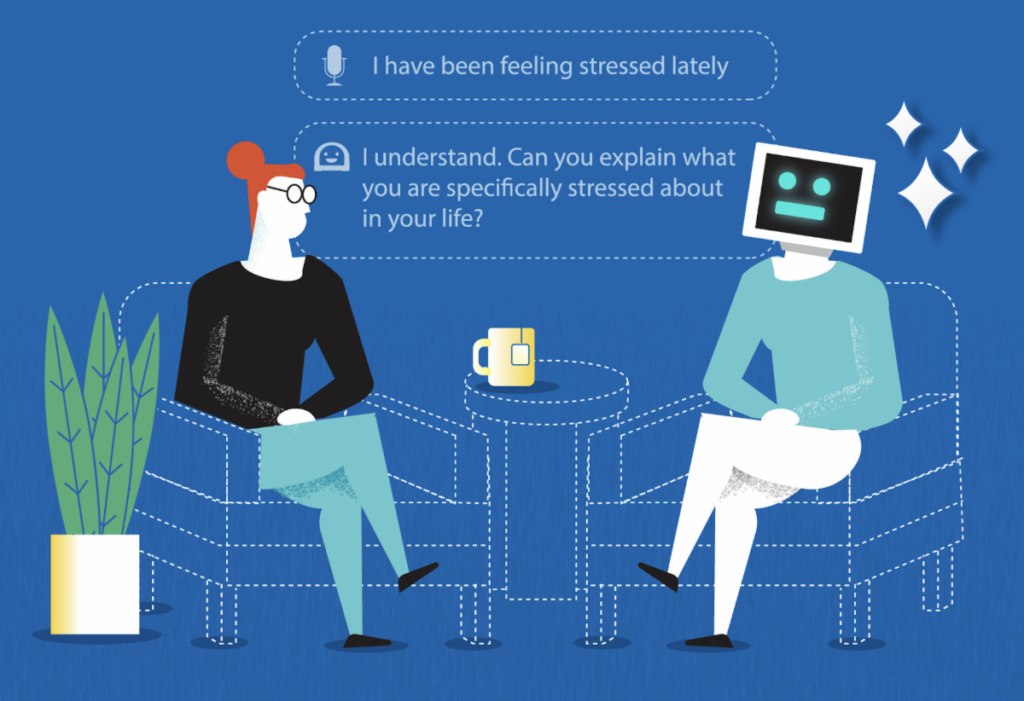
Two chat bots have a conversation.

AI Mental Health Chatbots May Not Be So Healthy

by C. Ben Mitchell, Ph.D

Apparently, AI therapy chatbots do not know that the first principle of medical ethics is primum non nocere (first, do no harm). Actually, they don’t know anything. Chatbots are not knowing beings; they are computational large language models (LLMs) that scrape data, predict how to respond to prompts, and spit out sometimes accurate and sometimes completely erroneous information (so-called hallucinations). Properly speaking, they are neither artificial nor intelligent. But many people, even in clinical medicine, seem to want to give AI the benefit of the doubt.

...read more

AI Mental Health Chatbots May Not Be So Healthy Read More »

Scotland the Brave

Recently, the Parliament of Scotland (building pictured above) displayed an uncommon act of “Scotch courage”, which had everything to do with moral fortitude and nothing to do with whiskey.  On 17 March 2026, following months of debate, the Scottish Parliament voted independently from the rest of the United Kingdom to reject a bill that would allow medical assistance in dying to terminally ill adults.  Apparently, this bill, when originally proposed over two ...read more

Scotland the Brave Read More »

A Step in the Right Direction

A Step in the Right Direction Read More »

A Time to Embrace and a Time to Refrain from Embracing — Artificial Intelligence (AI)

D. Joy Riley, M.D., M.A.

Executive Director

The day before Thanksgiving, I needed just a few items for the feast preparations. My mother accompanied me to the grocery store, and we, along with a large sector of the local population, searched the shelves. When it was time to check out, I saw the lines peopled by the harassed clerks, and opted for the self check-out region. After scanning a couple of the larger items, I clicked the “Skip Bagging” button on the screen, and placed them back into the cart. Nearing the end of the self check-out level of Purgatory, the machine ...read more

A Time to Embrace and a Time to Refrain from Embracing — Artificial Intelligence (AI) Read More »

Making Babies? An IVF Primer

D. Joy Riley, M.D., M.A.

Executive Director

The first successful in vitro (in glass) fertilization (IVF) resulted in the birth of Louise Joy Brown in 1978 in England. Here is a brief account of that event.

“It was a fantastic achievement but it was about more than infertility,” ...read more

Making Babies? An IVF Primer Read More »

Bioethics and Medicine: A Short Companion by C. Ben Mitchell

A Book Review

By R. Henry Williams, M.D., M.A.

Chairman of the Board

The Tennessee Center for Bioethics & Culture

What is the essence of medical ethics as it may or should be practiced today? What is an ethical physician? What is Christian ethics? How does one’s faith impact how medicine can be practiced? These questions along with a broad look at medical ethics, from Hippocrates to today’s practicing professional, are masterfully addressed in C. Ben Mitchell’s new volume, Bioethics and Medicine – A Short Companion.

Mitchell draws on his experience as a pastor early on, who moved into his career as a bioethicist and professor, partly due ...read more

Bioethics and Medicine: A Short Companion by C. Ben Mitchell Read More »

Who Is WHO?

A Visual Primer on the World Health Organization

by D. Joy Riley, M.D., M.A.

Executive Director

The World Health Organization (WHO) arose in the aftermath of WW II. Its aim as a global organization was sound “health” for everyone, whatever his/her socioeconomic position. The word health was wide-ranging in its definition: “Health is a state of complete physical, mental and social well-being and not merely the absence of disease or infirmity.”

First Director-General of the WHO: George Brock Chisholm

George Brock Chisholm, a Canadian, served his country during WWI. After returning home, he trained in medicine and then Freudian psychiatry. He advanced to become the first Director ...read more

Who Is WHO? Read More »

Reading the Mail of Others

D. Joy Riley, M.D., M.A.

Executive Director

Reading other people’s mail is usually and appropriately considered unethical.  There are a few exceptions.  One of those is when the correspondence is publicly available, even if not easily discovered.  A communication sent at the end of January, 2025, to the U.S. Food and Drug Administration (FDA) is a case in point.  The American College of Obstetricians and Gynecologists (ACOG), The Society of Family Planning, and the Society for Maternal-Fetal Medicine together submitted a “Citizen Petition” to the FDA about Mifepristone.  Mifepristone is the first of two drugs taken to induce an abortion in a pregnant woman.  The petitioners were urging ...read more

Reading the Mail of Others Read More »

23andMe is Sold to Regeneron:  What happens now? 

Joyce A. Shelton, Ph.D.

Professor of Biology Emerita

Trinity International University

23andMe is Sold to Regeneron:  What happens now?  Read More »