

Executive Director
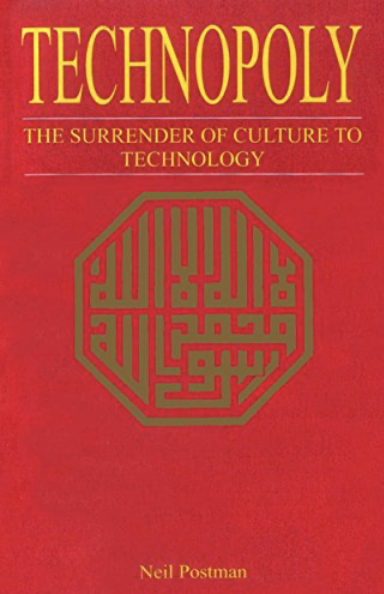
Neil Postman (March 8, 1931 – October 5, 2003), of the communication arts department of New York University, applies the tale of Thamus and Theuth to technology in his book, Technopoly: The Surrender of Culture to Technology (Postman {1992} 2011. Lahore, Pakistan: Suhail Academy). In Plato’s Phaedrus, Socrates and Phaedrus are having a discussion about writing. Socrates tells of a tradition handed down by the ancients, the myth of Theuth.
An old god, Theuth, dwelt in the city of Naucratis, Egypt, and was the inventor of many arts: astronomy, arithmetic, calculation, draughts, geometry, and dice. But his greatest discovery was of “the use of letters.” The god Thamus was then king over all of Egypt, and Theuth traveled to see the Egyptian king and others assembled there. Theuth showed to them his inventions, with the hope that all of Egypt would benefit from them.
Thamus evaluated each invention in turn, approving of some, and disapproving of others. Then they came to the letters. Theuth opined that these would “make the Egyptians wiser and give them better memories . . .a specific for the memory and the wit.”
Thamus replied, “O most ingenious Theuth, the parent or inventor of an art is not always the best judge of the utility or inutility of his own inventions to the users of them. And in this instance, you who are the father of letters, from a paternal love of your own children have been led to attribute to them a quality which they cannot have; for this discovery of yours will create forgetfulness in the learners’ souls, because they will not use their memories; they will trust to the external written characters and not remember of themselves. The specific which you have discovered is an aid not to memory, but to reminiscence, and you give your disciples not truth, but only the semblance of truth; they will be hearers of many things and will have learned nothing; they will appear to be omniscient and will generally know nothing; they will be tiresome company, having the show of wisdom without the reality.”
In the first chapter of his book, Postman addresses the wisdom of Thamus’ understanding of writing and the one error the king/god made regarding its use. Although Thamus gave “arguments for and against” Theuth’s other inventions, the king saw only the burden of writing letters; he gave no indication of perceiving a benefit therefrom. Postman proceeds to point out that “technology giveth and technology taketh away” (p 5).
Postman states that a technology’s functions follow its form. Once it is introduced, a technology does what it will do. Therefore, we need to have “eyes wide open” when we “admit a new technology to the culture” (p 7). Here are a few of his conclusions:
1) A new technology brings a new vocabulary, and changes the
meanings of old words. Television and the meaning of “political
debate” is but one example (p 8).
2) A new technology is accompanied by new winners and new losers.
Particularly does the term winner apply to those who have control
over the new technology.
3) One of the most important effects of a new technology is the
ideological change it introduces.
Postman serves up a telling example of the last one in the story of William Farish, an engineering tutor at Cambridge. In 1792, Farish suggested the assigning of grades to students’ papers, and it was done. Postman comments that this
. . . idea that a quantitative value should be assigned to human thoughts
was a major step toward constructing a mathematical concept of reality. If
a number can be given to the quality of a thought, than a number can be
given to the qualities of mercy, love, hate, beauty, creativity, intelligence,
even sanity itself.
. . . If it makes sense to us, that is because our minds have been
conditioned by the technology of numbers . . .
. . . embedded in every tool is an ideological bias, a predisposition to
construct the world as one thing rather than another, to value one thing
over another, to amplify one sense or skill or attitude more loudly than
another (p 13).
When a new technology arrives on the scene, it is in competition with older technologies. It is not only technologies that are facing off, as it were. It is the collision of world-views, according to Postman. He rightly concludes, “New technologies alter the structure of our interests: the things we think about. They alter the character of our symbols: the things we think with. And they alter the nature of community: the arena in which thoughts develop” (p 20).
In her recent article for Summit.org, Kehla Vance wrote about how Christians need to think about technology. Her questions about the possible adoption of technology for parents seem applicable to people of all ages, whether Christian or not. They are summarized here:
1) What is the purpose of this technology?
2) What does it make easier? What does it make unnecessary?
3) What does this technology replace/displace?
4) When repeatedly used, this technology forms what kind of person?
5) Can one explain why or why not s/he uses this technology?
It would be gratifying to see these examining questions widely applied by people everywhere. I think Socrates would approve.