

Middle Tennessee, like many other locales this week, is enduring snow, ice, and frigid temperatures. That brings some fresh irony to our beginning a new series on artificial intelligence (AI) and medicine — particularly to people who are trying to stay warm amidst power outages. We pray for your safekeeping, and hope that whenever you are able to come back online, you will enjoy our featured article and the other linked ones as well.

ARTIFICIAL INTELLIGENCE AND MEDICINE
(First in a Series)
D. Joy Riley, M.D., M.A.
Executive Director

AI and Truly Human Medicine
by C. Ben Mitchell, Ph.D
Professor and Author of Bioethics and Medicine: A Short Companion
Human medicine is one of the many arenas where AI is proving disruptive. It’s challenging to sort the hype from the reality, the promises from the pablum. Even more challengingly, if AI continues to develop at its current rate—or even speed up—it is impossible to say today what the practice of medicine will look like in 5 years, 10 years, and beyond. As a sage has famously said, “it’s difficult to make predictions, especially about the future.”
Not being able to say everything about AI and the future of medicine, however, does not mean there is nothing to say. For instance, human medicine must attend to our humanity. Despite the claims of the materialists among us, most people repudiate the notion that we are just meat machines. We are complex biological organisms with capacities for rationality, social engagement, communication, and spirituality with flourishing as our telos. We are not merely brains in a vat, but possess both material and immaterial properties: brains, minds, and consciousness. The practice of medicine worthy of the adjective “human” must take into its embrace the whole person.
Medicine is more than a branch of science, of course; it is a profession, a covenantal relationship between one who is trained in the art and science of medicine and one (or more) who is embodied, vulnerable, and who may be suffering from illness or other dis-ease. Physicians are not “providers of services” but those who practice in the context of a morally freighted profession where “doing good for the patient, not harm” is the first principle. Trust is one of the products of the covenant when the relationship between physician and patient is virtuously protected and embodied. We know too well that trust is difficult to earn but easily lost.
Artificial Intelligence is not human and will never be human. It’s a tool, a “machine” that requires demystification in the current moment. Although not everyone will be familiar with the structure of large language models (LLMs), AI is not, as someone quipped, rocket surgery.
Most word processors and text messaging platforms work according to the rules embedded in LLMs. When I’m typing this sentence, the LLM is programmed to mine the internet for the possible ways that sentence might continue and offer the most likely candidate. “Arti” is often followed by “ficial.” “Roses are . . .” is often followed by “red.” That’s what the autocomplete algorithm does. It may seem like voodoo, but it is built on the 1s and 0s of a binary logic very familiar to computer programmers and software developers. Yes, the tool is becoming increasingly sophisticated, but it’s just a tool.
AI is also a mirror. That is, the tool scrapes vast amounts of data that all of us have put on the world wide web, from the texts of books, magazines, journals, pictures, images, and other forms of art. When we make a query through an AI platform like ChatGPT, Grok, or Copilot, the tool scrapes the internet to find the most likely answer to our query and feeds that back to the user.
A notorious problem, however, is that the LLM abhors a vacuum. If there is a lack of data, it may “hallucinate” (a better term is confabulate) or just report false data. In writing legal documents, for instance, the LLMs have cited court cases that never happened. Similarly with scientific journal articles.
A recent essay in Science, the journal of the American Association for the Advancement of Science (AAAS), warns against AI slop and notes that, “no system, human or artificial, can catch everything. Potential degradation of the literature by technology reinforces the value of a record maintained with human scientific experience and expertise.”
The University of Hong Kong was embarrassed late last year when one of its professors published an article in a peer-reviewed scientific journal that included twenty references that were invented by AI. “They looked legitimate. The titles sounded academic. The authors’ names seemed plausible. There was just one problem: Twenty of the references in a peer-reviewed academic paper didn’t exist at all.”
The early evidence, then, shows that AI tools are a mixed bag. The axiom that we shape our tools and they in turn shape us is as true with AI as any other tool. And there are both potentials for good and potentials for ethical errors with every technology. Flexible plastic tubing, surgical instruments, and mechanical ventilators have all shaped the practice of contemporary medicine. In many cases they save lives. In some instances they raise moral conundra that even rise to the level of precedence-setting legal cases.
Vigilance will be required to sort through the AI hype to stay alert to the potential for harm. At the same time, by keeping humans in the loop, AI tools may prove extremely valuable in the future of health care.
In each article of this series, we’ll look more deeply at the potential promise and peril of AI in medicine while being acutely aware that what we say about the future is always contingent.
AI in Tennessee Law
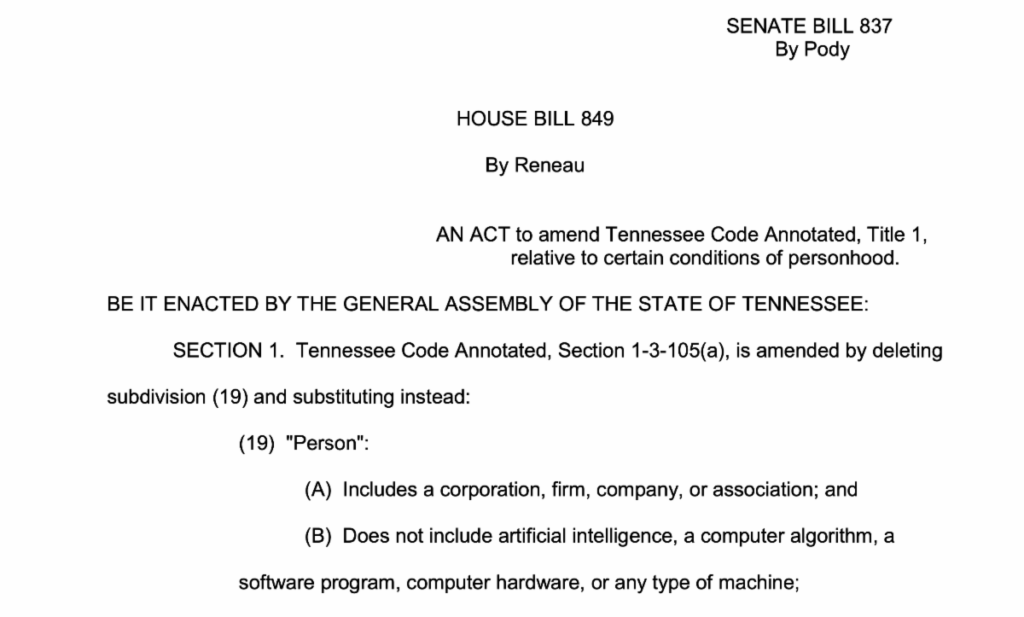
Tennessee House Bill 849 (HB0849) addresses the term “person” in light of AI entities. Read the text of the (draft) bill here.
Update: Tennessee House Bill 849 (HB0849) passed both the House and the Senate and officially became Public Chapter 781 on April 28, 2026.
Another bill of note, HB1470/SB1580 — regarding AI not being able to act as a qualified mental health assistant — can be found here.
Update: HB1470 / SB1580 successfully passed and was signed into law by Governor Bill Lee on April 1, 2026, officially becoming Public Chapter 647. The law takes effect on July 1, 2026.
Will Lyon, in his excellent article, “Doctoring and the Device Paradigm,” helps us separate the iPatient from the real human, flesh-and-bone embodied patient. It is worth your time.